Part Three · free chapter 1
What We Choose to Carry
Something That Fits
Reading in order? Later-book samples may reveal earlier events.
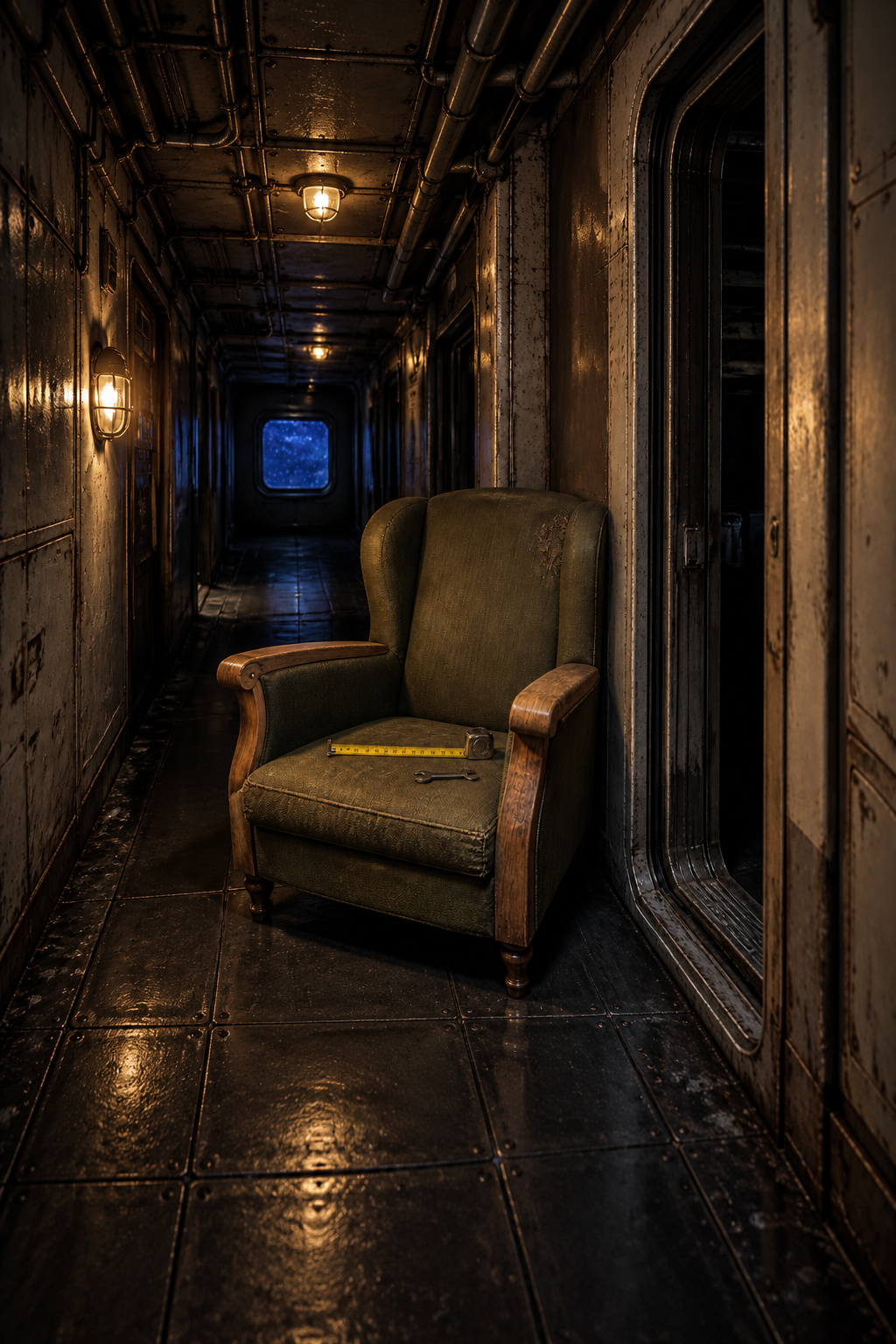
Oren had bought a chair that would not go through his door.
Eli found him in the passage above Bellwether's freight office, standing beside it with a measuring tape. The chair was upholstered in an unpleasant green. Its arms had been repaired with different kinds of wood.
“Was it free?” Eli asked.
“Almost.”
“They should have tried harder.”
Oren extended the tape across the doorway again.
On the twenty-sixth morning without the Spare Room, Eli still sometimes woke reaching for the edge of a berth that wasn't there. The floor did not make the right sounds. His steel cup cooled faster than the grey one had. He had learned to stop mentioning these things whenever Oren liked something about their new rooms.
“Turn it,” he said.
“I've turned it.”
“The other way.”
“That was among the ways.”
Eli bent to take an arm. Oren moved the tape out of his reach.
“Not now. You're due downstairs.”
“You'll block the passage.”
“Then people can sit while they complain.”
Eli left him measuring the chair's legs.
In the freight kitchen, Neri had covered half the table with route drawings. She had finished repairing the yard lighter the previous week. She had then gone away for two days without telling Eli where, and come back with a revised survey and an invoice.
He had paid the invoice before asking about the survey.
“Thirty days,” she said, tapping Tamsin's signed agreement. “Four left.”
The freight concession would end in ninety-six hours. Bellwether's new anchor could still carry small boats to the clinic and the ice works. It could not bring fuel or filter assemblies from Ansel. Those travelled on routes the Directorate controlled.
At the other end of the table, the council representative unwrapped a used water membrane. A grey crease ran across it.
“This came out of the clinic circuit last night,” she said. “We have one replacement rack left. At the present rate, we install the new assemblies before the concession ends or begin rationing the tanks.”
“How much time in the tanks?” Eli asked.
“Eighteen hours for essential use. None of that is a reason to waste them.”
There were six new filter assemblies waiting in an independent warehouse at Ansel. Bellwether had paid for them. Each sat inside a protective frame large enough to make transport expensive. Under Continuance, the Directorate would move them that afternoon, then convert the freight charge into household contribution requirements.
The council representative had brought the offer too. She put it where everyone could read it.
“If this route of yours cannot carry them, we sign,” she said. “I won't make people drink a principle.”
Neri spread the drawings over the edge of the contract.
The route did not look impressive. On Rusk's maps, freight moved in bright, broad lanes. Neri's route was a broken thread along the margins.
Ansel's old municipal service yard still had an independent departure anchor. An unfashionable passage connected it to Mooring Six, a little maintenance station farther out in the system. From there, another short passage ought to reach Bellwether's receiving network.
The first link had been tested. The second had not.
“Not ought,” Eli said.
Neri looked up.
He had spent the last three weeks correcting those words on his own plans. Ought. Probably. Enough.
“All right,” she said. “We have maintenance records. We haven't made a loaded transit.”
She drew a second line from Mooring Six to Bellwether.
“Ordinary engines. Twenty-four hours at the proposed mass. Fuel aboard for thirty. That's our fallback.”
“We can do it tomorrow?”
“We can inspect it tomorrow. Then you get to ask again.”
The freight worker who had first recognised the depot list sat on the other side of her.
“My sister's kept Six open,” he said. “Hessa. I told her you wouldn't ask her to hold a gate together with a positive attitude.”
“No,” Eli said.
“She'll want that in writing.”
They had spent twenty-three days finding owners, replacement seals, crews and actual prices. Two promising depots had turned out to be empty shells. A third was somebody's home. No one had asked those people to leave.
Ansel had finally authorised a limited trial from its service yard. Three councils had agreed to buy places on the route if the test worked. Their money would pay for fuel, staff and an independent safety officer. Nobody's access to water would depend on wearing a cuff.
Eli had wanted more signatures.
The council representative had asked how many journeys they could guarantee next week.
They had kept the three.
A message arrived on Neri's reader. She did not turn it over this time.
“Lev's review,” she said. “Still no decision.”
She opened his message before the clinic's. A photograph showed a chair joint sketched on the back of an envelope.
“He says he doesn't want a workshop visit,” she said. “They keep arranging them. He wants to watch the boats.”
“Can he come here?”
“He can travel. His room and treatment are another question.”
Eli looked at the contract beneath the maps.
Then he moved his hand away from it. Neri could read it herself.
Oren came down carrying the chair's seat cushion. He put it beneath the council representative, whose stool had lost its padding, and asked what they had decided.
When the meeting broke up, Eli waited while he read the full route plan.
“Two passages,” Oren said. “Separate operations. We land between them.”
“Yes.”
“And if somebody stops?”
“The ship stays in a real dock until we choose something else.”
Oren ran a finger along the conventional leg.
“Good.”
Eli watched him reach for the blue notebook. The old dread rose, quick and familiar. He had thought understanding it would make it less physical.
“Do you want to come?” he asked.
“As a mechanic. I'll decide about navigation after the test.”
“All right.”
Oren looked up, briefly surprised, then went back to the figures.
On the shelf above them, the third cup remained upside down. Tamsin's cup, although nobody had formally assigned it. Eli wiped dust from its base with his thumb.
Her latest message contained three corrections to their fuel allowance and a date for her custody review.
Beneath those, she had written: YOUR CONVENTIONAL ROUTE NEEDS A RECEIVING CREW. NOT JUST SOMEONE TO CLAP.
Eli added a line to the plan.
Keep this chapter.
Save the free sample in the format that suits you, then explore the other books.
Explore the other books